In Plain Site: the (New) Detroit Landmarks of Stan Dolega

Updated: Aug 15
(All historic images courtesy of Stan Dolega unless otherwise indicated)
For more than 50 years, Sunset Point, the scenic westernmost tip of Detroit’s Belle Isle, has been home to a mysterious and provocative presence: a six foot tall minimalist sculpture comprised of two massive steel forms mounted on a concrete base.
In his invaluable 1980 guidebook Art in Detroit Public Places, critic Dennis Nawrocki described the sculpture, created and installed by artist Stan Dolega between 1970-72, as consisting of "two steel gray rectangles whose exterior edges are rounded and interior edges are square, and which are separated by a two-foot gap creating a definite, almost magnetic tension."

Today, the sculpture—which is officially untitled but nicknamed "Silo"—bears only a passing resemblance to the one Nawrocki described, and the tension he found so compelling is long gone. In 2008, the artwork was profoundly altered by representatives from the City of Detroit's Recreation Department, who sawed the concrete base in half, relocated the pieces, set them at oblique angles, and painted them dark green. (More recently, they've been painted back to their original battleship gray, a decision presumably made by the Michigan Department of Natural Resources, which now governs the park.)

By all accounts, the City undertook this reconfiguration to expand and reroute a nearby pedestrian path. Why the new path wasn't simply designed to go around the sculpture, or why it became necessary to break "Silo" apart so indiscriminately, remains unclear. 18 years later, I suppose it's enough to say in a general sense that "Silo" was not understood or prized, and so—like much urban environmental art in and around Detroit—it fell victim to indifference during a complicated, cash-strapped period of the city's history. Since then, it has carried an unintentional quality of disorder. It feels forlorn, forgotten about. Unfinished.
To Stan Dolega, who was born in Detroit in 1942 and moved to Wyoming in 1978, these changes do more than deface his sculpture, which he placed on Sunset Point with great intention and care; they fundamentally invalidate it. "My original intent is now destroyed," he wrote in 2013.
Even so, "Silo" possesses an attraction to Detroiters, a curious allure. Tanya Stephens, a preservationist and public art advocate, describes it as "another perfectly hidden in plain sight Detroit gem." She says she always makes sure to include it in her public art-themed bike tours of Belle Isle. The installation artist, sculptor, and photographer Scott Hocking told me that Dolega's sculpture was one of several around the city that productively challenged him, as an up-and-coming artist in the 1990s, "to think about art in a way I hadn't before." He paid homage to "Silo" by documenting it in a series of photographs after its reconfiguration.

Those of us who admire "Silo" hold out hope that some day, it will be reconstituted and appreciated for what it is: a powerful post-industrial totem and an important piece of Detroit's cultural heritage. That hope is not unfounded. Dolega built his sculpture to last, and the materials are still in good shape. So it's entirely possible that with the right amount of willpower and investment, the worthy cause of repairing this broken landmark will one day be achieved.
In the meantime, I'm compelled to tell the story of "Silo" alongside its two long-lost companions: a pair of short-lived but extraordinary interactive earthwork sculptures Dolega built in Detroit parks in 1974 and 1975. Considered together, these three environmental artworks are more than historical curiosities. They are forward-looking experiments in the use of art to creatively reshape urban landscapes and uplift the diverse souls who inhabit them.
DETROIT EARTH ARTIST
Though it has been more than 50 years since he moved out west, Stan Dolega is a Detroiter, through and through: proud, determined, skeptical, and scrappy.

Born on the east side in 1942, he was educated at Michigan State and Wayne State Universities. After earning his MFA at Wayne, he became a full-fledged member of the Cass Corridor artist tribe that flourished in the central city in the 1960s and '70s. They were an innovative and close-knit group who became known for their energetic incorporation of cast-off industrial materials into their art.
The Cass Corridor artists were profoundly place-based. They lived and worked in close proximity, and the art they made often reflected the post-industrial landscape they inhabited. Dolega made "Silo" and other minimalist sculptures in his studio at Common Ground, at Cass and Prentis, and co-founded and showed his work at the legendary Willis Gallery on Canfield (currently Kitab Cafe).

When we spoke in 2020, Dolega recalled this period as one of revolutionary liberation—a time when Cass Corridor artists participated in the broader consciousness-raising of the day by casting off the shackles of art history and pursuing their own individual visions as far as they could take them.

Over the course of his long career, Dolega's vision has led him decisively toward environmental art. His is not art for art's sake. It is a willful attempt to introduce stimulating creative energy into the landscapes he inhabits, whether urban or rural. A sculptor and land artist, his diverse works range from structures made of steel, stone, and wood—such as the sprawling, 17-ton Wind Code, integrated into the site of the Southeast Wyoming Welcome Center in Cheyenne in 2012—to art made from the Earth itself.

Dolega's most ambitious piece of land art is an enormous 1981 earthwork he created on the site of an abandoned coal mine in Hanna, Wyoming. Covering 120 acres, with changing elevations from zero to 100 feet, Dolega's great earthwork was an attempt not only to sculpt the land, but to make a real difference in his environment—in his words, "to solve…multiple problems of garbage pollution and contamination, ugly eyesore, local recreation needs, and wildlife habitat."

Produced in partnership with the US Bureau of Land Management, the Natural Resources Conservation Service of the USDA, and the city of Hanna, the finished work includes sculpted landforms as well as functional amenities like a landfill, rifle range, and dirt bike course.
When we spoke in 2020, Dolega told me that he first started dreaming big at Wayne State in the late 1960s. At the time, he said he confounded his conservative teachers with semi-abstract steel sculptures that were inspired by his love of 1950s science fiction movies. These were relatively small works, a couple feet tall, but he imagined them existing "very large in the landscape."

His sculptures actually became large-scale, and decidedly more abstract, once he graduated and began working out of a spacious studio at Common Ground.
NEW DETROIT LANDMARKS
At 6 by 12 feet, "Silo" was the largest sculpture Dolega fabricated in his Cass Corridor studio, and it marks a turning point in his work. Its conception as a site-specific outdoor artwork—a feature of the Sunset Point landscape—illustrates his evolution from studio artist to a creator of place-based interventions.

It was also his first opportunity to put his art to work as a force for the common good. The commission to create "Silo" came from New Detroit, Inc., an influential civic coalition that used public art as one of many remedies to help heal the city after the devastating uprising that had gripped it, for five deadly days, in July 1967.

The New Detroit committee was led by governor George Romney, mayor Jerome Cavanagh, and businessman J.L. Hudson, Jr. They mobilized leaders from local businesses, labor unions, government agencies, and community organizations to pursue a vigorous utopian project: dismantling systemic inequality in the wake of the uprising. Working from abundant evidence that the unrest had been the result of decades of racism, police brutality, and economic disparity, their efforts touched virtually every aspect of civic life in Detroit, from housing and criminal justice to youth affairs and public art.

Between 1971-74, New Detroit used a combination of local and federal dollars to commission 16 Detroit artists—including Dolega, Michael Hall, Lester Johnson, Charles McGee, David Rubello, and Hanna Stiebel—to create abstract murals and sculptures at locations of their choice throughout the city.
These were notably not monuments, with fixed meanings to impose. Instead, they sought to create new shared experiences among Detroiters by introducing new visual and social energies into the scarred urban landscape. They also provided unprecedented opportunities for young artists like Dolega, who were invited to take an active role in resolving the urban crisis by simply doing in public what they had been doing behind closed doors: making art.
Dolega, then in his early thirties, used the opportunity to create his most ambitious sculpture yet, and to install it on Sunset Point, where it would be seen by scores of visitors against the dramatic backdrop of the Detroit and Windsor skylines.
AMONGST THE GIANT MACHINES
"Silo" is, by design, an understated work of art. Its simplicity and restraint led Dennis Nawrocki to refer to it in 1980 as "perhaps the most difficult sculpture on Belle Isle for the general public to understand." A 1972 Detroit News article by Luther Keith supports this claim, quoting various visitors likening it to a "water supply tank," "some type of disposal bin," or "a couple Detroit Edison substations." (The perception of "Silo" as an indeterminate piece of municipal infrastructure endures. On a recent visit, I asked some passersby what they thought it was. One studied it for a good minute before venturing, "An…electrical…box?")
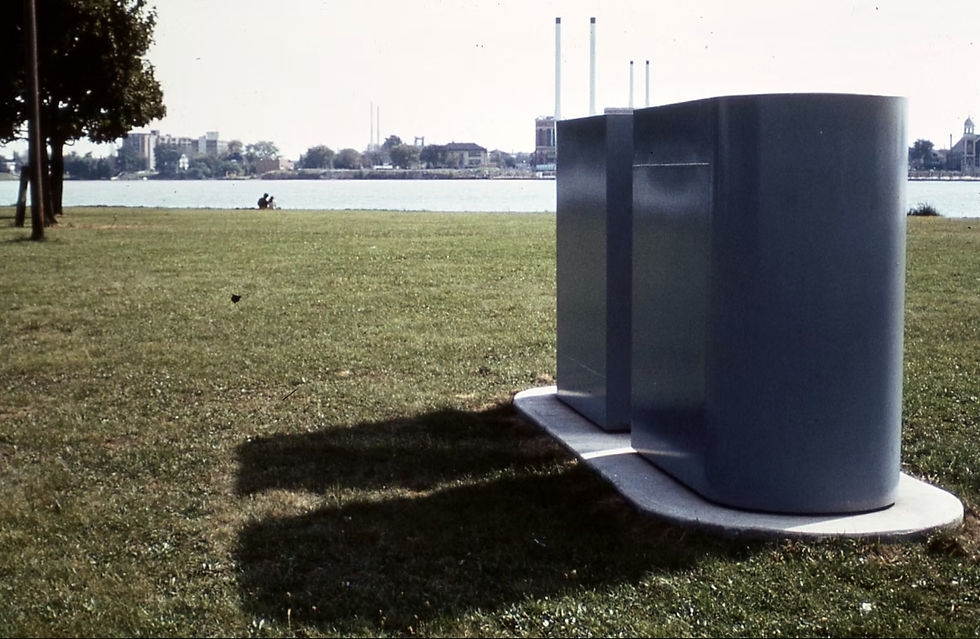
But if it caused some head scratching in its early days, "Silo" was also celebrated and admired as a bold statement by a young artist of promise. In a 1972 Detroit News article, the paper's spirited midcentury critic Joy Colby, who had a real sympathy for contemporary art, waxed poetic about it, calling it "a new landmark for Belle Isle" and even puckishly elevating it above Marshall Fredericks' celebrated 1958 "Spirit of Detroit" in the local public art pantheon. Here's her take on what she referred to as "Silo"'s "big, blunt forms":
Why should [they] seem at once menacing and serene? Ordinary and mysterious? Empty and full? Prosaic yet somehow magical? Simple but quite complex? The answer, of course, lies with Dolega's growing powers as a sculptor. He is a native Detroiter, who once worked in a stamping plant…. His works come closer to the real spirit of Detroit at this particular moment than the sentimental and inflated "Jolly Green Giant" in front of the City-County Building.
To appreciate "Silo" as Dolega conceived it, it helps to understand a concept that is central to his practice. He describes his sculptures as "fictionalized objects"—made to "resemble reality closely without being any one actual thing." He elaborated on this concept when he wrote, ''Building sculpture is like writing fiction. The end-product relies on the experience of the author. It expresses feelings about their lives at that point. Art does not necessarily reflect the beautiful, just like all books don't have happy endings ... to appreciate sculpture, education is not a prerequisite; you see what it is saying, you wonder what it's about."

When I asked him about the feelings that informed his creation of "Silo," Dolega cited his experience growing up "amongst the giant machinery" of post-war Detroit. He spoke about the childhood bus trips he and his brother took to their grandfather's hardware store on the west side in the late 1940s and '50s. During these journeys, he marveled at "the huge industrial capacity that made Detroit the arsenal of democracy during World War II."
By the 1960s, that capacity was waning, but it remained a force in the local culture and economy, as Dolega came to experience firsthand. He spent time working not only in a stamping plant, but also a shipyard, where he helped built a yacht. You can see these influences all over "Silo"—from the craftsmanship of its precise welds to its vaguely nautical forms.
When we spoke, Dolega noted another key influence that accounts for both the sculpture's nickname and its prominent placement on Sunset Point: the hulking cement silos that used to hug the shoreline of the Detroit River—a dominant feature of the landscape until their demolition in 2005.
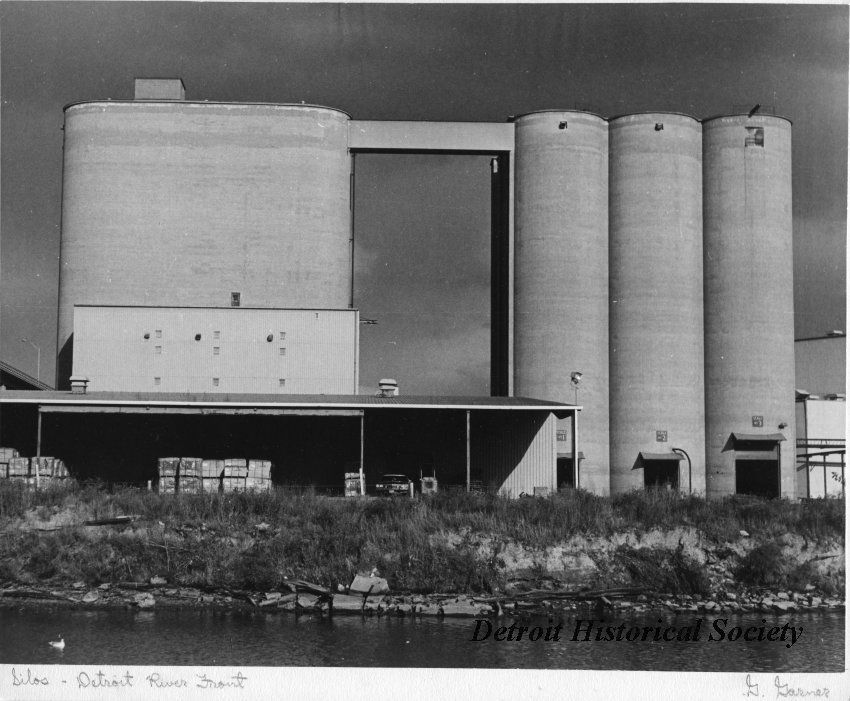
Dolega told me he installed his sculpture on Sunset Point so that it would communicate visually with the silos. He set the two forms "in a tight configuration…on the same compass bearing that all the streets in downtown Detroit came down to the river, and of course that meant it was parallel to all those rounded silos down there."
But the intentionality with which "Silo" was conceived and placed in its site was not meant to define or limit the piece. While it grew from Dolega's own experiences and sensibility, the sculpture was meant, after all, for the public to encounter, not in a dutiful spirit of meaning-making, but rather of curiosity and imaginative play.
"In a way, I build these things like a child would," Dolega told me. "They're like playthings for me, and I'm inviting my friends—that is, the audience—to play with me."

Early photos of the artist with the sculpture hint at how interactively he intended it to be experienced: not just regarded from a distance but touched, passed through, even climbed upon. Seeing it this way, you get the sense that you—the participant—are meant to complete the work by physically exploring it, by positioning yourself as the hinge or connective tissue between the two forms.
The meanings that follow this movement liberate "Silo" from a strictly post-industrial reading. They show it to reflect not only the physical landscape of late '60s and early '70s Detroit, but the social one. Do the complementary shapes of Dolega's New Detroit sculpture reference the historically adjacent but divided cultures of White and Black Detroit? Yes, I believe they do—suggesting that it was up to everyday Detroiters to extend themselves across racial lines to break the monolithic tension between them. But, as Joy Colby implied in her list of contradictions about "Silo," they also do more than that, and less. The point is not in the particular, but the general. Animated by the social and political awakenings of the 1960s, Dolega's sculpture positions the public as the protagonists of the unfolding American story, who through everyday local acts exercise our power to make change.

Dennis Nawrocki hinted at these socially conscious undercurrents in 1980, when he considered "Silo" alongside the more familiar historical sculptures that dot Detroit's island park. "Curiously," he observed with characteristic pith, "the piece also resembles a pair of statueless pedestals, forms that one finds in several traditional Belle Isle monuments."
One monument Nawrocki likely had in mind is the bronze statue of Major General Alpheus Starkey Williams that has stood for more than a century at the intersection of Inselruhe and Central Aves. Williams was what you might call an august personage—a Union general in the Civil War as well as a lawyer, judge, journalist, bank president, and congressman—who was memorialized, along with his horse Plug Ugly, by sculptor Henry Merwin Shrady in 1921.

Seen in early photos, "Silo" does indeed bear a resemblance to the great mass of granite on which Plug Ugly and his illustrious rider reside. But Dolega's deconstructed pedestal is no mere support surface for a Great Man of history to stand frozen upon for a century or more. The hero of this story (not pictured but implied) is the city. The people: diverse, changeful, and ever in motion.
In this light, "Silo" can be read as an interactive anti-monument that reflected the searching, unsettled spirit of its time, when old narratives and power structures were being regarded with new skepticism amid widespread inequity, uncertainty, and unrest. "Silo" invited the public to clamber onto it, one citizen after another, and embody the radical call for change that the New Detroit Committee made when they wrote, in their 1968 Progress Report, "We, through what we think and how we act as individuals, have the most critical responsibility of all. There are no longer any other hopes for saving this society. And collectively, there is no greater power than what we ourselves contain."
LANDMARKS LOST
Visiting Dolega's New Detroit sculpture today, it takes considerable imagination and knowledge of its history to sense even a trace of the social consciousness embedded in its stolid steel forms. If the piece was difficult to understand in 1980, it is now all but incoherent.

But as long as "Silo" remains physically broken, imagination and memory are the best ways we have of understanding it. And nothing helps crystallize its civic aspirations better than the memory of its two long-lost successors: a pair of interactive artworks Dolega built in Detroit parks with the help of local youth in 1974 and '75.
These commissions came from the City of Detroit's Recreation Department, which also used public art to strengthen social ties in the wake of the uprising. The City's efforts introduced a crucial community dimension to this movement, enlisting Detroit youth to help create public artworks as a means of earning summer employment and recreation opportunities.
Dolega, for his part, was happy to have help realizing his next projects, which were only growing in scale. Having made his anti-monument on Sunset Point, he was ready to get free from traditional sculptural forms altogether, in favor of fantastic landscapes that blurred the line between art and architecture. With a decidedly more organic character than "Silo," these large-scale works reflected formative experiences the artist had far from Detroit's big machines, in northern Michigan and the American West, where he hiked, camped, and studied historic structures like barns and earthworks. The primary materials for both were wood and earth.

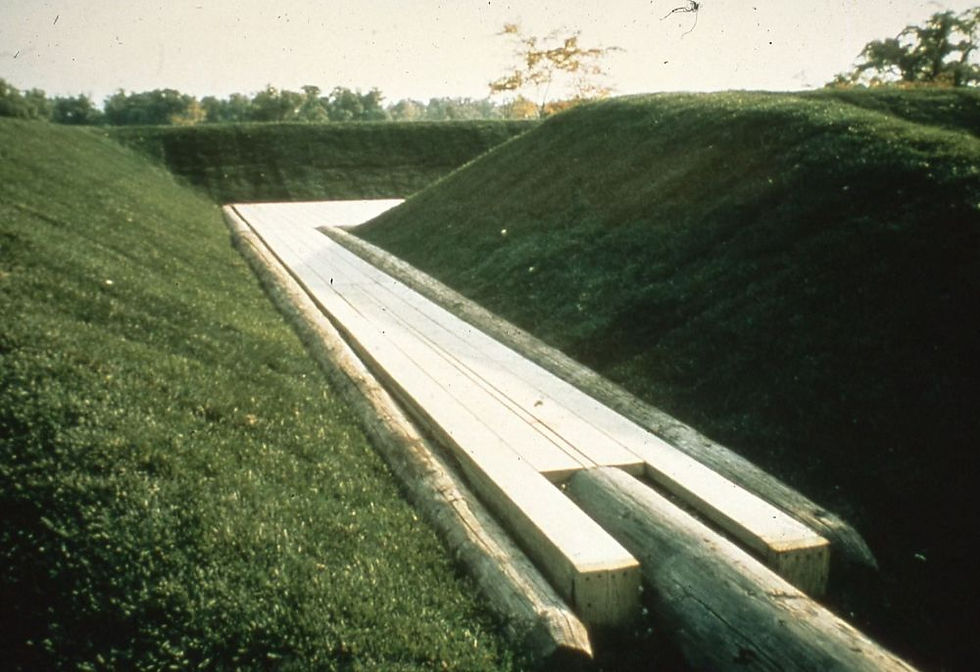
The first, an untitled 65' x 32' earth work and play structure, was located near "Silo," on the north side of Belle Isle, east of the Detroit Yacht Club and across the river from the popular mid-century nightclub the Roostertail. Dolega described its genesis to me in 2020:
I built three huge wooden structures in my studio and showed them in the Willis Gallery in a one man show. One of them was a flat platform that rested on stones. A high-up at the Recreation Department came to me as a result of seeing that show and asked me if I would be interested in entering a competition to build a sculpture, but I'd have to work with children of various ages on Belle Isle.
She'd seen my work, so I simply said to her, "I will let the final site that I choose determine the shape and form and materials of the final piece of sculpture. And I will go with the children and work with them on the beaches using sticks and stones and sand, and we'll play around with ideas together. Ultimately, we (meaning me and the children) will pick one of their works and I'll expand on that, and we will build it."
And so they did, co-creating a flat hilltop with a deep depression in which a square platform was secretly nestled. Adjoining the platform was a balance beam that protruded from the hill and could be seen from a nearby parking lot, enticing curious viewers to get closer.

Dolega described the piece as "a small fortress and play sculpture that kids could find," which would "open up to [them] as a kind of surprise once [they] got up to the top of the hill." He estimates that 30 children were involved in the ideation phase, with another 10-12 teenagers helping with construction—a process that involved a bulldozer, shovels, rakes, and "big saws to cut up heavy timber, like you see old time lumberjacks with."

"Controlling space," Dolega said in summary of this rare and remarkable piece of collaborative urban land art. "Shaping space. Emotions. Fun."
One young participant, Bill Merriman, had so much fun that he teamed up with Dolega again the following year, working as his assistant on the artist's third and final environmental artwork in Detroit: an interactive sculpture of extreme horizontality in Clark Park, in southwest Detroit. Officially untitled, it also earned a nickname: "Ozone Bridge."

Here again is Dennis Nawrocki, describing the Clark Park piece in Art in Detroit Public Places in 1980:
This 64-foot wooden "structure/sculpture," as artist Dolega has described it, is very different from his untitled gray steel sculpture on Belle Isle, yet both represent his responses to urban structures. The bridge-like piece, which also resembles an elevated sidewalk or catwalk, emerges from a low-lying hill and rises steadily in a long sweep to a height of about six feet, where it ends abruptly in midair. The large scale of Dolega's public sculptures invites physical exploration by the viewer. In the Clark Park piece, the viewer can climb the sculpture and, protected by high railings, can have an expansive view of the park. The sculpture does not function as a crossing but rather as a transition, from one height to another, from one place to another, from one view to another.
Reflecting on the sculpture in 2024, Dolega wrote, "Commissioned by the Detroit Recreation Department, I was given a free hand to do an 'environmental sculpture.' It was set up pointing directly at the rising sun the day we starting building at 5:30 am June 21, 1975."
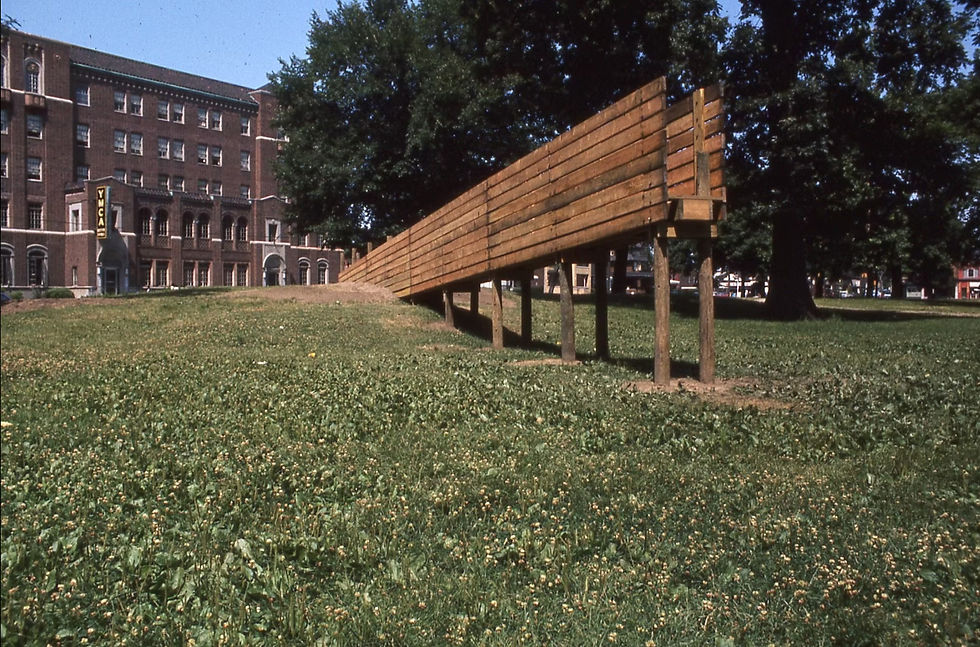
Unfortunately "Ozone Bridge" did not last long in Clark Park. When we spoke in 2020, Dolega recalled that it was set on fire within a few years (he doesn't know by whom) and subsequently torn down by the city. The Belle Isle play sculpture and earthwork, meanwhile, was "destroyed within a year" from neglect, according to the artist. He told me that he built it with treated lumber, which he expected to last for 25 years, but "the city just didn't take care of it."
I pleaded with them. We staked all the sod on it down…. They wouldn't water it, they wouldn't fence it. They paid for all this stuff, and then they let it go to hell. I've got pictures of it going to hell but I never look at them. That was the beginning of my training, my serious training and schooling as to what happens to your artwork if it's out in public, and people just don't give a shit.
Not long after, he told me, "They bulldozed it. I don't think you'll find a trace."
Unlike "Silo," which the artist told me he made to last "virtually forever," these two works were not intended to be permanent. But neither were they meant to disappear as quickly as they did. Had they lasted the 25 years Dolega had envisioned, they might have stood in their locales until the year 2000, subtly softening some of the hard edges the city became known for in the 1980s and '90s. The opportunity cost of their short lifespan is the generation of Detroiters who didn't have the chance to encounter and use these works: to interact with them and talk about them. To be at rest among them. To feel proud of or challenged by them. To wonder what they were about.

Like the mistreatment of "Silo," their untimely demise is a loss to those of us who admire Dolega's work and share his conviction that public life can be energized, in productive ways, by thoughtful artistic interventions. But such losses also reveal something essential about public art, which is by definition messily entangled with people, power, and place. These were not just sculptures, but signs of the times. As such, they were ultimately subject to some of the very forces they were commissioned to resist—namely the unjust tide of decline, disinvestment, and disregard that washed over the city in the second half of the 20th century, and which has only recently begun to recede.
Seen from the vantage of our current era of reinvestment and renewed civic pride, Dolega's Detroit sculptures look downright prescient. Consider them alongside celebrated recent developments like the giant play structures of Ralph C. Wilson, Jr. Centennial Park on the west Riverfront, or the 24-foot tall sculpture that Erik and Israel Nordin created and installed on Belle Isle in 2022, which, like "Silo," comprises two complementary steel forms that invite participants to pass between them. The values and practices embodied in both of these projects—interactivity and play, physical exploration, connection to place, the renewal of the post-industrial landscape—are the same that distinguished Dolega's work more than 50 years ago.
SERIOUS PLAY
Pay a visit to Sunset Point today and find yourself on a wedge of land that plunges, like the bow of a great ship, into the Detroit River. To the south are the stout, spread-out structures of the Windsor skyline; to the north, the tight, soaring masses of Detroit's. Westward down the snaking strait lie the bridges, the antique Ambassador and the state-of-the-art Gordie Howe, and of course the famous sunsets, which on clear evenings cast an all-encompassing celestial light upon this earthly urban landscape.
There among picnickers and park benches, roller skaters and fishing boats, "Silo" rests. At the scale of the human (the artist's height, in fact) and bound, as we are, to the land. An impassive import from the cool Cass Corridor, full not of spectacle or pageantry but mystery, subtlety, and the ghost of its former grace. Its twin forms invite conjecture and participation while muttering half-heard truths about industry, equality, and place. If it was put back the way it was meant to be, I think it wouldn't mutter but hum and murmur, and the transmission it was built to broadcast would be clearer to those who stop and listen: fill the gap. Bridge the divide. Seek balance within yourself to oppose the restlessness and chaos of the world. Resist violence and fear with visible acts of creativity and local care.

Stan Dolega placed "Silo" on Sunset Point during a time of tumult and uncertainty in Detroit and across the nation, a time defined by social unrest, racial and economic tension, and acute anxiety about the future. In the face of division and discord, this work embodied equilibrium and poise. Wonderfully, it met the awful force of public violence with an inducement to public play, encouraging Detroiters who were deeply divided to come together in simple, shared experiences of surprise and discovery.
In this way, it recalls another spirit of Detroit, the activist, community leader, and writer Grace Lee Boggs, whose life and work spanned the city's long, post-industrial decline and tentative rebirth. She maintained that only a revolution in American consciousness and interpersonal relationships could cure us of our terminal tendencies toward injustice, alienation, and violence. In a statement published near the end of her life that seems apt when considering the legacy of "Silo" and its companions, she wrote, "A revolution that is based on the people exercising their creativity in the midst of devastation is one of the great historical contributions of humankind."


